A living herbarium, one species at a time.
Thirteen years spent documenting the English Setter the way one would document a rare species: with patience, precision, and a notebook that's always open.
It started with a sketchbook, not a breeding plan.
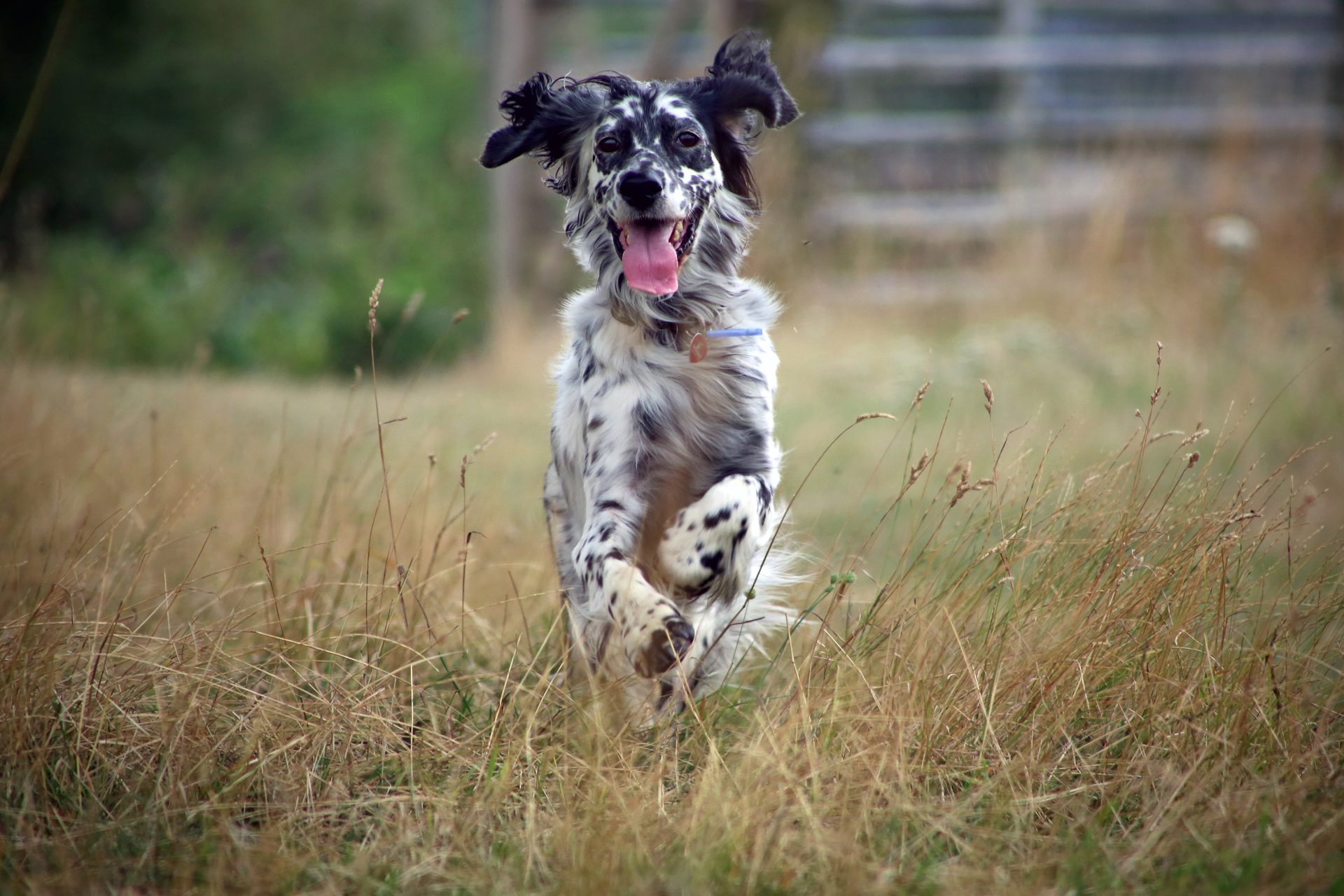
Élise Vandal spent nearly ten years illustrating specimens for a biology faculty's herbarium — plates of insects, ferns, mounted birds, each one paired with measurements and an observation card. Then Darwin arrived: an English Setter adopted "for the house," who ended up taking over every drawing table.
Observing this dog with the same rigor as a laboratory specimen — weight, posture, reactions, coat markings — Élise realized no breeder documented litters this way. Planches Naturalistes was born in 2013 from that simple idea: treat every puppy with a naturalist's eye for observation, without ever losing the warmth of a family dog.
The kennel moved to Bromont in 2016, to a property with real fields to run in and the quiet space that careful illustration work requires.
The inspiration: the Laverack and Llewellin lines.
This engraving of a Laverack-line English Setter, taken from a 1904 sporting book, has hung in the studio since day one. Edward Laverack fixed the breed's type in the 1850s; Purcell Llewellin then developed its hardier field-working branch in the 1870s.
Our own breeding dogs, Audubon and Linnéa, descend from both traditions — Laverack's bearing, Llewellin's field endurance. It's that continuity, documented for over 150 years, that our illustrated record card tries to carry forward.
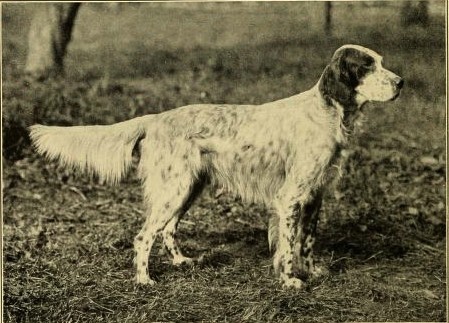
Joseph A. Graham, The Sporting Dog (1904) — public domain.
What sets a naturalist's cabinet apart from an ordinary kennel.
Three habits that haven't changed since the first litter.
One breed, in depth
Thirteen years devoted to the English Setter alone let us know its bloodlines, coat colors and needs better than if we bred several at once.
A record card per litter
Every litter gets its own illustrated record card — sketches, measurements, temperament notes — given as a copy to each adopting family with their puppy.
Always open to visitors
You can visit the kennel even without a firm plan. A breeder who hesitates to show you their facilities tells you something — here, the door stays open.
Come meet Audubon and Linnéa before you decide.
We welcome families by appointment in Bromont, even before a litter is born. You'll see the studio where the record cards are drawn, meet both breeding dogs, and ask every question — including the hard ones.
Audubon and Linnéa are health-tested (hips, eyes, hearing, DNA panel) before every mating; the full detail of their testing and pedigree is on the Our Bloodlines page.
Want to visit the Cabinet?
Whether you're looking for a puppy this year or simply want to learn about the breed, we answer every question, with no pressure.